Monday, June 27, 2022

A Ghost of Power - A Short Story

     "A Ghost of Power" was written originally for a competition hosted earlier this year by the Classical Association, a competition that I was ineligible for as it was only open to UK residents. Despite this, I took it as a personal challenge to see if I could meet the proposed deadline anyway; I did, though the story still ended up being well-beyond the required word count. Written during the 2022 Chinese New Year holiday, it preceded the Russian invasion of Ukraine by nearly a month, so the story's original impetus had nothing to do with that, though it would be easy to draw parallels between this story (based on a different "historical" invasion) and the ongoing invasion. 

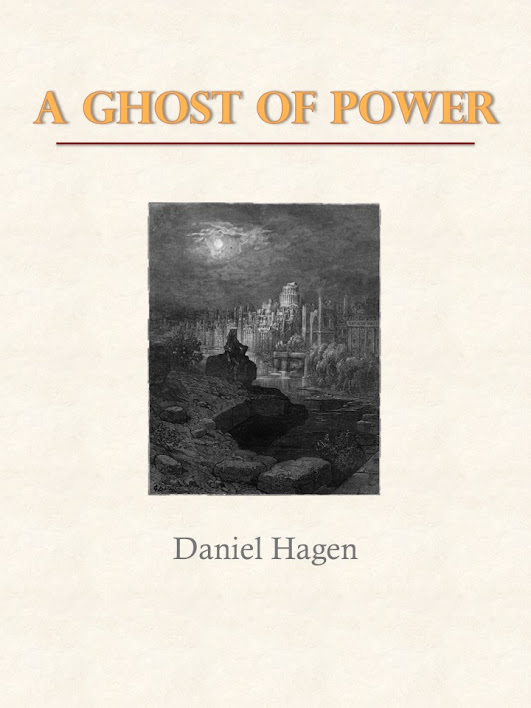
    More to the overall point of (though also not the inspiration for) the story is the image reproduced below on the "cover" page: Gustave Doré's 1872 etching 'The New Zealander' which shows an imagined scene of a ruined London being viewed by tourist as one would take in the ruins of the Acropolis, the Pyramids of Giza, or Chichen Itza. I found the image in an article for BBC culture by Paul Cooper - The timeless allure of ruins - describing the fascination with ruined civilisations taking place in European culture throughout the 18th and 19th centuries. Cooper notes the "fearful portents" the Europeans of the day read into the "crumbling remains of previous civilisations": 'If Rome could fall, could it also happen to London, or Paris?' 

We know well enough the answer to that question.

Special thanks to MD and LG for comments and feedback. Also, I hope my attempts to create a more pleasing look come across with this post; I've found Blogger's formatting options to be excruciatingly limited and inconsistent, so I don't know about you, but I've found I'm much happier with the results this time around. 

Thanks and take care!


Sunday, April 4, 2021

Imperium Sine Fine - A Short Story

       This is an updated version of the previously published work titled Imperium Sine Fine, primarily featuring a new, more aesthetically-pleasing layout. Apart from that, there was one significant addition to the story itself as well as two quotes which now preface the story. Enjoy! - DH

Tuesday, March 23, 2021

A Finger Pointing to the Moon: An Essay on Reflection, Water, Darkness and Light

This is an updated version of the previously published article featuring a new layout. Hopefully, the improved presentation will add to reading experience by making the article both easier to read and more attractive to the eye in general. Thanks! - DH


Thanks to MD and LG for feedback and editing.

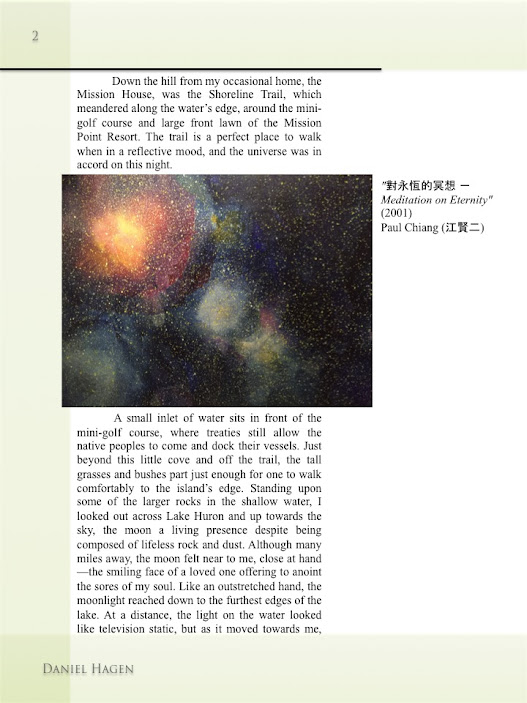
The art featured here is by Taiwanese painter, Paul Chiang, whose work has been used without permission; the photos were taken by myself. His website can be visited here.


Friday, January 29, 2021

Free Will: What is it and do we have it?

by Daniel Hagen

"Bewilderment" by Vin Scheihagen

               The nature of free will and its very existence have been discussed among scholars and philosophers at least since times of antiquity in both eastern and western societies. Today, it is a topic for study in the sciences as well among physicists and neuroscientists alike. I am certainly more philosopher than scientist in this respect as I have more experience in simply living and observing life around me than I do in any of the labours of the hard sciences. The following is the personal observation of one raised in a Christian household and culture, in which the concept of free will was largely taken for granted, who became a Buddhist and has developed a closer relationship with his own mind through the study of Buddhist philosophy and meditation. It is not my intention to present a definitive answer on the question of free will for the world but rather to answer the question—with the knowledge and experience I have—for myself. For you, the reader, may it inform and be of service to your own search for answers to the question of free will.


The Conversation


            As our young son was taking his bath, my wife lay on the sofa staring up at the ceiling. We had been together long enough for me to know when something was weighing heavily upon her mind.

            “Is everything okay?” I asked.

            “Oh, I’m feeling a bit melancholy,” came the unsurprising reply. I should add that I also know that when my wife is in a certain mood, it is best to leave her be to sort through it on her own. So with that in mind, I cautiously inquired further: “Any particular reason?”

            She went on to tell me that she had been thinking about a friend who had died some years ago. A couple years before we met, my wife lived and studied in France. It was there that this particular person had befriended her, invited her to her dorm to talk, and helped her acclimate to life at the university. As they were both Taiwanese, my wife expressed sincere gratitude at the memory of this young woman and the assistance she had provided.

            My wife went on to tell me she had met this friend again after some time apart to find that she had changed drastically. Her appearance had so altered that my wife was moved to ask if she was all right or unwell. The friend simply stated that she had been under some pressure and left it at that. A few weeks later, she was dead. This young woman, while living in France with an older man, had fallen to her death in what was declared a suicide. Though my wife had heard rumors here and there over the intervening years as to the possible causes and conditions that would lead to her death, she had no certainty as to what had actually happened.

            Fourteen years later, the memory of her friend’s death troubled my wife so greatly that she contacted other friends who had also been in France at the time and were likewise acquainted with the young woman. One thing that troubled my wife in particular was her inability to remember the young woman’s name. None of her other friends, when asked, could remember either, though as some small comfort, my wife was eventually able to find she had written the young woman’s name down in one of her journals.


            So it was that my wife and I began discussing the purpose of life and how each of us comes to make the choices in life that we do. Do we have the freedom to choose our own paths in life? Can we change the course and direction of our lives when they appear to be going in a direction we don’t like or that makes us unhappy, afraid, resentful? What is it that allows some of us to live our lives in relative ease while others suffer tremendous hardships? Do we really have a choice at all? Do we have free will?

            I had only the previous evening been having a similar conversation with a friend I was visiting. He expressed dismay at the feeling that human life seemed ultimately pointless in the grand scheme of things. He, like myself, was troubled by the enormous division in our home country, the US, as evidenced by the recent presidential election. We were both disturbed by the level of support given to a man we considered to be immoral, self-centered, and clearly inept, not to mention the willingness of so many to either give into delusional conspiracy theories or willingly and knowingly traffic in falsehoods. It is to the detriment of society, if not humanity as a whole, that so many have such a slender grasp on reality, and when so many are actively exploiting our irrational fears and ignorance, one can’t help but wonder what hope there is for our species.

            Meanwhile, my son was drawing a picture on my friend’s daughter’s easel-board, which we dubbed “Polyphemus” owing to its resemblance to the one-eyed Cyclops of Odyssean lore. My son, at the time, was just shy of 4 years old, so the interpretation was entirely ours.

            My wife is currently in the final year of a Master’s degree, studying to become a guidance counselor. As such, her work as an intern brings her into close contact with both the elderly, lonely or troubled in their twilight years, and the young, detached from parents and peers alike. Much like the memory of her friend in France, the conversations she has with troubled people on a daily basis lead her to question the purpose of life, given that it seems so inexplicably difficult for some but not others. Of course, it is clear that we all have our crosses to bear; no one’s life is without suffering. Every age of human life and every period in human history has had its hardships, and our time is no different in that regard. And yet, we live in an age that is also unlike any other. Ralph Ellison, in a 1967 discussion on the merits of public television, stated that “as the American people becomes aware of itself, it discovers itself. We do not know as much as we should know about who we are, what we are, and how we differ.” This awareness now applies to all of humanity; we are learning more about ourselves every day, through TV, film, literature, music, social media, and of course the sciences. We increasingly understand what makes each person what they are and why, though the totality of any one person remains a complex web of genetics, heredity, environment, culture, physiology, neurology, psychology and so forth. So where, if anywhere, does free will lie? 


Different Lives, Different Conditions


            In addition to the sad tale of my wife’s unfortunate friend, I would like to present two other life stories. Indeed one could examine any human life and see only a part of the vast tangle of causes and conditions that make that person what they are. No matter what we may discern from the visible aspects of any one life, no matter what information may be available about them, and provided we are able to separate fact from rumor, the actual workings of all other minds apart from our own are forever obscure in their totality. Even our own minds, as I will get into later, are often obscure to us for a number of undeniable reasons, though one reason is of particular significance. The two people whose stories I will relate were different in significant ways, but each story presents particular questions about the nature of free will and the mind.

Huang Hua-cheng

            Recently, my wife, our son and I took in the final day of an exhibition on the life and work of Huang Hua-cheng (黃華成), a Chinese-born, Taiwanese avant-garde artist and playwright. At the forefront of the avant-garde movement in Taiwan in the 1960s, Huang was not well understood by his contemporaries. As a result of the difficulty and frustration in expressing and promoting his ideas, much of his work has been lost, left unfinished, or unproduced, and he made a living primarily by designing book covers. His uncompromising attitude to his work apparently made him difficult to live with; he was divorced before he died of cancer in 1996 at the age of 61. I was personally struck by his 1965 play The Prophet, which reflected many of my own thoughts about art and commercialism with such prescience; the world moves so quickly now that all art—whether music, literature or the visual arts—is in a constant state of surpassing and being surpassed to the point that art has, in a very significant way, lost any real meaning. Huang stated, “Art will rot, and is actually rotting now. New art is always better than old art.” But at the same time, in The Prophet, “Man is sick of surpassing others, and even more sick of surpassing himself,” and also, “I want to erect that immortal milestone.” The name of the exhibit was given in English as An Open Ending, but my wife explained that the Chinese title more appropriately translated as “unfinished”.

Lisa as a child & prior to execution
            Regarding the second life story, I recently read about Lisa Montgomery, a woman who, at the time of writing, is set to be the first woman to undergo execution by the United States federal government since the 1950s. Her crimes are undeniably horrible: She stole a baby from the womb of a woman eight-months pregnant, killing her to do so. While one may rightly say it was an evil act, we should also recognize the evil that was done to Lisa Montgomery throughout the course of her life. She was born in a troubled household to a mother that did not care for her, and she was abused physically and sexually throughout her youth. Her stepfather allegedly raped her and invited others to rape her repeatedly before she was 14. What’s more, when her mother learned of the abuse, not only did she do nothing to protect her daughter, she threatened her daughter with a gun. These are but a sampling of the litany of horrors visited upon Lisa Montgomery consistently and continuously throughout her young life. What possible choice could a person like this have in the course their life takes when they have been so brutalized? What kind of mind could such a person have? 

            What do these two stories say about free will or the lack thereof? Huang Hua-cheng was an artist. Why? What compelled him to pursue the path that he did? Did he choose it or did it choose him? Could he have chosen a path less fraught with difficulty? Could he have relinquished his persistent need to push the boundaries of art? Could he have done something entirely different with his life? Could he have avoided his cancer or made different lifestyle choices? As someone who has studied and created art, I can understand how an idea can grab the consciousness of a creator as if willing itself to be born, and I have also travelled a path that has made the creation of art a painstaking, laborious and seemingly fruitless pursuit. Huang Hua-cheng is still remembered and his art still lives. Would that be enough to have satisfied him? Would he accept that he had fallen short of erecting “that immortal milestone”?               
                Those of us who have not suffered the abuse that Lisa Montgomery suffered should count our blessings. For all that society preaches on the virtues of responsibility and respect, what could Lisa Montgomery have known of such things? What was the responsibility of her mother, her father, her stepfather and others that abused her? Moreover, what kind of respect could she have had for herself, much less for anyone else? Did anyone in her life nurture the humanity that existed within her, or was that humanity so thoroughly snuffed out at an early age that there was no hope of reviving it? Others imposed their wills upon her—upon her body and her mind. If she had a mind of her own, would she not have done something to protect herself? And yet, how could she have protected herself when she was only a child? It was not her responsibility to teach her mother how to love her daughter. It was not her responsibility to have to protect herself from sexual abuse. And who made the choice to tell her that she had a right to love herself, to be loved, and not to be abused? No one, apparently.


The Sense of Self


            So do we have free will? The answer seems to be, at the very least, variable. No will can be entirely free, as all choices are dependent upon whatever causes and conditions make up the present moment. The Buddhist concept of karma is relevant here. Karma literally means ‘action’; it is a popular misconception that karma refers to the result of one’s actions—a result that rings of poetic justice to those who do wrong and of heaven’s proper reward for those who do right—but no, karma is action—specifically, the actions we choose to make, be they words or deeds. Thus, free will appears to be the ability to choose our karma, but as mentioned, our karma, or potential action, is always dependent upon whatever is happening in the present moment and can never be otherwise. A wealthy American may be able to consider whose services they want to employ to design their outfit for, say, the Met Gala, whereas a Sudanese refugee may be forced to consider doing terrible or dangerous things simply in order to survive. Free will, in this respect, would appear to be a luxury.

            Regardless of wealth or poverty, a person’s free will may be more or less constrained by any number of other factors: duty or obligation, societal norms or taboos, parental expectations, mental or physical capacity, etc. What’s more, our wills are subject to the whims of our most basic needs: hunger, fatigue, sickness, the need to evacuate our bowels, and so on. But could we say that, despite or even in spite of such constraints, one individual can have more or less free will than another? Or even none at all? To be clear, having no free will at all is not simply to suggest a person who is enslaved but rather something more fundamentally broken in a human being—a person incapable of considering and who can only react. Lisa Montgomery may be such a person. 

A total lack of free will, of course, could also suggest a person who is comatose or in a vegetative state. However, even then, we should consider the phenomenon of locked-in syndrome; consider the story Jake Haendel, who despite being apparently comatose spent several weeks fully conscious and aware of his situation. It is entirely possible that an enslaved person may have a freer mind than the person by whom he or she is enslaved; based on the Buddhist concepts of the mind, desire, and aversion, it is almost certain that the mind of a person who can “rationalize” slavery exists in alienation to itself. Regardless, an enslaved person would indeed require a strong sense of self to endure such inhumane and degrading circumstances and remain convinced of their inherent human value and dignity. It is such a sense of self—an authentic and unfiltered sense of self—that may be at the core of one’s capacity for free will.

            Most of us will understand the reference to this “sense of self” by another term: ego. Like karma, ego is largely misunderstood; someone who has “too much” ego is arrogant, self-centered or even narcissistic, whereas someone who has “little” ego is weak-willed, indecisive, a sheep. It is often believed that the purpose of Eastern philosophies such as Buddhism is to dissolve or even annihilate the ego, but not only is that a bad idea, it is impossible to actually do. The purpose of Buddhist practice, for example, is not to dissolve the ego itself but rather to eliminate the misconceptions and filters that form around the ego and that we think of, mistakenly, as the self. These misconceptions can range from destructive mental habits to self-misconceptions that are based on mistaken concepts of culture, race, or religion that prevent us from experiencing inner peace and a clear perspective on our true natures.

            What the “self” is, whether soul or spirit or simply consciousness, is another discussion, but it may be appropriate to suggest that the ego is the “sense” in “sense of self”. Like the other five senses, the ego is a portal through which stimuli enter. (Neurologically speaking, the ego would seem to correlate with the amygdalae, which filter out and focus our attention on the various stimuli as necessary, primarily determined by that which we desire, fear, or are indifferent to.) It could also be said that through our actions and words as well as the functions of our body, stimuli are also transmitted out of these portals. Though this may be more obvious for some senses than others, what is most significant is that the mind is a portal operating in both directions. In Buddhist philosophy, the mind is the sixth sense. We can readily accept that the ego has a role in processing stimuli such as those received through the nominal five senses of sight, sound, smell, taste and touch. Taking a step further, we can also accept that such stimuli may produce a response or reaction, whether fight or flight, aversion or desire, or something in between. So what is it that exits out of, or rather through, the ego? Thought.

            That thought exits through the ego rather than out from it is an important distinction to make. This is perhaps one of the greatest misconceptions of the human mind: that thoughts are birthed from what we think of as our “self”, the ego. They are not. Thoughts emerge from “below” the ego, from what is typically called the subconscious. But here’s the crucial part: The ego can be “detached” from this “field” of the mind from which these thoughts actually grow. The ego is not the field; the ego observes stimuli and reacts depending on our personal conditioning and how closely the ego is laid upon this field of the mind.  Too close and the ego may mistake these thoughts for authentic expressions of the self rather than for what they essentially are: the spontaneous bubbling up of mental flotsam and jetsam: products of memory, association, dreams and nightmares.

            The ego, as part of the conscious thinking machine, may and often does make use of these bubbling thoughts and put them to creative purposes. How creative or destructive these thoughts become for us depends on our proper use and understanding of the ego. The better our understanding of the ego, the more free will we may have.


            Meditation, for example, especially meditation that is focused on observation of the mind, body and/or breath as opposed to meditation focused on a chosen mental object—a deity, mantra, or other symbolic focus—is a way of training the mind so as to “put some distance” between the ego and the field of the mind from which thoughts arise. This practice involves having or developing equanimity—a sense of balance and non-judgment— toward the thoughts that arise so that they may pass away of their own accord; a thought grows from this “ground” and if we choose not to tend to it—to water it, so to speak—it will die away naturally. Better still, we may become more attuned to the thoughts that actually matter; thoughts that arise from fear, anger, sadness, desire, joy and pleasure are not necessarily good or bad. Fear can be rational as much as joy can be irrational; knowing the difference between the two—whether a feeling is rational or irrational—is a very valuable kind of knowledge indeed.

            Increased awareness of the interplay or relationship between the ego and the field of the mind gives us the means to better and more honestly know not only ourselves but also others, not to mention the whole of the world around us. For example, your friend may love a song that you, for whatever reason, loathe. It is not necessarily the point of increased self-awareness to explain why you do or do not like something, though it may help to. It may also help, however, to understand that as you yourself connect to different things than others, so too do others connect to their own preferred things: a song, a book, a painting, a place, and so on. By more fully understanding what you yourself connect to and why, you may also begin to appreciate—though not love or even like—what others connect to and why. At the very least, you will likely understand that there is little point in worrying about what other people like—unless it is potentially harmful—when you can spend more time enjoying what you like for yourself. This is just one way in which free will is enhanced by a well-developed sense of self.


The Garden of the Mind


photo by Daniel Hagen
           It seems to me that there is always a purpose in life, crystalized in the choices and actions of any and every given moment. These karma are, for the most part, simple, mundane, and largely inconsequential, be they putting one foot in front of the other, grasping an object with our hand, or closing our eyes to sleep or simply shut out the bright glare of the sun. Consider even these simple (and often unconscious) actions, however, and you may realize that not everyone can make even these choices.
            So it may have been for my wife’s friend, Huang Hua-cheng, or Lisa Montgomery, that owing to the circumstances of their lives, some quantity, quality or fundamental ability to exercise free will had been lost. Just as I, in my life, have felt compelled to follow certain paths—as were in my nature to follow—so am I compelled to write this now. The difference may simply be that I “walk” this path willingly; I have chosen it as much as it has chosen me. I am acutely aware of how grateful I should be to have the life that I do. Furthermore, as much as I’ve struggled at times to find my purpose in life, I realize that my life was always meant to unfold one way or another; whichever way the wind blew, I would inevitably find purpose as long as I was willing to accept the purpose that life had bestowed upon me, however joyful, terrifying, or ordinary that purpose may have been.

            I can consider myself lucky, but not everyone—perhaps a considerable number of people throughout human history—has been so fortunate. As mentioned earlier, our own minds are often obscure to us, and one of the most significant reasons for this has been studied in the field of child development. Recent studies have shown that the first three years of a child’s life are critical and have long-term consequences on their personalities, development, and ability to relate to and interact with others. If this is true—and it seems entirely plausible—what does that say about free will? All children begin life not only without self-awareness but also absolutely dependent upon the people who happen to be around them. Typically, a child is raised by its biological parents, but there is no guarantee that the child’s parents will be good parents; even if they are basically decent, they could also be incompetent, uneducated, impoverished, burdened with physical or mental difficulties or poor health, any of which could make raising a child difficult. (Ironically, these same conditions may provide a child with the opportunity to develop strengths they otherwise would not.) A child, through no fault of its own, may also be born with physical or mental challenges; likewise, a child may be born with traits that are at odds with its parents’ or society’s belief system, such as being born with a “taboo” sexual preference; even a physical disability or albinism may be seen as the result of superstitious belief in some cultures.

            Of course, a child’s parents may also be objectively bad: physically or mentally abusive, negligent, cold, selfish, or otherwise emotionally unsupportive or distant. Regardless of wealth or status, a child with such parents may have plenty of material possessions, access to good schools, and potential security in financial or societal terms but remain just as flawed as any child born in poverty and even, in a sense, be spiritually worse off for all of the distractions such a materially-rich but ultimately superficial life may bring.

            Finally, a child may be born and raised by a single parent or left with no parents at all. One good single parent who has reasonable resources and support is better than two bad ones, of course, but what of a child who has no parents? Maybe relatives step in, maybe they don’t. Maybe a child is adopted, maybe shuttled through a series of foster homes, maybe raised in an orphanage … maybe in a wealthy country, maybe in a poor one. Maybe a child is made an orphan by war and left to survive or die in a refugee camp. 

            The point is this: No child has any choice when it comes to the circumstances of its birth. No child has any control over who, if anyone, will raise it. And yet, we are all formed in significant ways by these circumstances and in these times that are entirely beyond our control and, in those very earliest years, beyond memory and conscious awareness.

         An infant has no free will.

         In other words, if free will exists, we are not born with it.

    If free will exists, it must be such that it develops with the emergence of consciousness just as only a fully grown tree can bear fruit.

        Consciousness, or at least one’s sense of self, is affected, if not shaped and formed, by circumstances present from the time of birth and, in fact, even before it. (Even in utero, the growth of an embryo/fetus is affected by the health and circumstances of the mother.) In summary, a consciousness may become free or develop free will, but such development is not guaranteed, as we are all to one degree or another saddled with a number of restrictions or limitations that prevent the consciousness from experiencing a complete sense of freedom. 


From the Primordial Ground

Polyphemus by J.H.W. Tischbein
            Polyphemus, it may be said, was born to be the man-eating monster of Homeric legend, but even this is uncertain. The Cyclopes of earlier stories, the children of Uranus and Gaia, created and gave to Zeus the thunderbolt in obeisance to the king of the gods. Polyphemus, son of Poseidon, however, lived not among the gods but in the “world of men” with others like himself, uncivilized savages who had no regard for the gods of Olympus. However, there are no monsters in the “world of men” anymore. The children of the old gods and the Titans of creation were all destroyed in the age of Hercules, or so the story goes. Now the gods themselves are no more than stories, hatched from the minds of human beings long forgotten, long since returned to dust and scattered who knows where. The only monsters are those that are born, live and either thrive or perish in our own minds. Whether we become monsters and whether our minds are free to confront and challenge the monsters within us is not always up to us. We may not be born monsters, but we can all too easily be molded into them from the same clay from which the old gods first molded humanity.

           We are all born from the same primordial ground, from the same dark, distant, eternally opaque “beginning”. We are all born in darkness, our very own conceptions belonging as much to the chaos of universal creation as those of the multitude of stars, nebulae and black holes spread throughout time and space. At the same time, although we are born ignorant, absent of self-awareness, and helpless, we are also born with the potential of everything that “the ancestors knew and have transmitted to us as seed.” (Amadou Hampate Ba) But just as no seed can grow if something in nature does not exist to nurture it, no human life can be lived with any free will if it is not taught how to develop it.

            As father to my own child, I have a significant part to play in the person my child becomes. If my sense of self is resilient and truthfully engaged with reality, I may yet help him to become a man, a human being, with his own sense of self built upon a solid foundation of clear understanding. I also do not know in what ways I may yet damage him and his sense of self; I can only hope and pray that I do not. I can only try to do my best. As long as I have any free will at all, there, but for the grace of God, go I. 


Special thanks to MD and LG for suggestions and editing.

Friday, November 6, 2020

Dear America: A Personal History

 Dear America,

            Though I have been away for the better of eleven years, more than a quarter of my life, never could you be far from my thoughts. You are, after all, the land of my birth, the cradle of my infancy, and the hearth and home that nourished my youth and saw me grow into adulthood. For better or for worse, by virtue of your inherent contradictions, I am both the man you raised me to be and, perhaps, a prodigal son fit to be scorned for squandering the inheritance bestowed upon me by the fortunate circumstances of my birth.

            It is precisely because of these contradictions – yours as well as my own – that I am compelled to write to you now. Your own birth, at times touted as the auspicious blessing of a divine creator, was in fact fraught in a number of ways that you have never fully reconciled even as the memories of past traumas stubbornly persist and manifest themselves in your aches and pains today, like the flaring up of an old war wound or a stoically repressed PTSD.

            It’s better I start with myself then. After all, our contradictions are intimately intertwined: You are in my DNA.


            I was born into a conservative, Christian household in the year of Ronald Reagan’s ascendency to the White House. I grew up in the city know best as home to the fictional oil magnate J.R. Ewing and as where the very real assassination of President John F. Kennedy took place: Dallas, Texas. Of course, others will be more familiar with its Cowboys, its Mavericks, its Rangers and, probably less so, its Sidekicks. (Professional indoor soccer was a thing in the 80s.)

            We grew up, my four older brothers and I, in a middle-class neighborhood. We went to decent schools; three of us even attended a very well respected private school, though I only attended for two years. In any case, we were never what you would have called rich and certainly not wealthy. All the same, I never once questioned that we had it pretty good. Never in my life, even when my Dad was laid off, once when I was 4 and again at 21, did I ever have to worry about having a place to sleep, food to eat, or something to do with my time. What’s more, our parents loved us; in sometimes imperfect ways, but they loved us and took care of us. Always.

            They taught me responsibility by taking their responsibility for their own children to their own hearts.

            We grew up in a home where everyone was welcome. Hispanic and Black kids from one brother’s soccer team were regular visitors. Jewish friends from the private school came often. My oldest brother brought Black and Asian friends home on visits from university. We hosted kids from Venezuela, Mexico and Thailand for the Dallas Cup, a youth soccer tournament, as well as exchange students from Germany. The husband of my mom’s best friend had emigrated from Palestine; he’d let me help out around their house whenever I needed to earn a bit of extra money. In my first trip abroad, we accompanied another of my Mom’s friends to visit her family in Peru. It was my mom in particular who encouraged us to learn languages and about other cultures just as she encouraged me to learn the language of my German forebears.

            They taught me to respect others and myself in the way that they showed respect to others by being welcoming to anyone who happened to come to our home. 

            Don’t get me wrong. My parents weren’t social activists. They didn’t march for any causes. They didn’t always say or do the right things. They simply tried to be good and decent people. They tried not to be swayed by societal fears or grandiose sermonizing but trusted their own judgment, knowledge and experience. This doesn’t mean they didn’t get things wrong, but fortunately, when I think of my parents, I can be grateful for all the things they managed to get right.

            As I grew older, however, the contradictions between how I was raised and the wider culture around me became more apparent and eventually impossible to ignore. 


            As a child, I liked President Ronald Reagan – little as I actually knew him, of course – simply because he looked like my grandfather. His smiling, wrinkled face and dye-black hair led me to dub him, affectionately, “Ronald Raisin.” It was with a child’s naivety that I believed that things that appear alike must be alike, but I knew nothing about his politics or the choices he made as president. I knew nothing about how the world I was born into had been shaped. His was the last picture in our then up-to-date book of American presidents, a book full of white, male faces; at the time, I had no reason to believe that this was anything other than normal or that it could be considered a testament to the disproportionate value given to some people at the expense of others.

            But then, as I grew up, I learned about the slave trade. I learned about the continuing encroachment of European settlers upon native lands, the treaties and promises broken, and the resulting violence. Even after amendments were passed to enfranchise previously enslaved Black men and women, state and local laws were passed to mitigate or nullify those gains. “We” fought for the right to representation in our own war for independence and yet have continued to deny fair representation to others even today. Just consider the citizens (American citizens!) of D.C., Puerto Rico, Guam and other US territories who are even now not afforded the same rights or the same level of representation as those born or living in the 50 states.

            Japanese American internment camps. The Chinese Exclusion Act. Jim Crow. The unjustified and barbaric yet casually forgotten lynchings and massacres of natives, Blacks and LGBTQ people. Shadowy CIA operations throughout Central and South America. Even subjecting unwitting participants to scientific experimentation, infecting them with syphilis, malaria, bubonic plague, viral hepatitis, and so on. These are things “We” have done. Even our Cold War fears of communist subversion and world domination must seem naïve and irrational in hindsight. Surely we can see that the ends never justified the means. Surely we can acknowledge the hypocrisy of past – and some current – actions. Surely we can admit that because of our fears and our lack of faith in constancy to our own ideals, we gave up the very things we professed to hold dear and sacrificed our very integrity. Surely we can admit that we have done wrong. (And, to be fair, we have admitted it a time or two.) 

            It is by no means to take away from what we have done right. Nor is it to make an example of us alone as if to hold ourselves apart from all others in the course of history or to hold ourselves to such a high standard as to deny our basic and decidedly imperfect humanity. Nor were all things done, in hindsight, entirely without justification or reason, though our actions – or reactions – have so often been disproportionate to their causes. At the very least, by admitting our mistakes, our failings and our shortcomings, we may yet become “the land that has never been yet.”

            It is difficult not to look at the United States today with a critical eye, having been raised in schools that repeated precepts like scripture – “Be respectful of others”; “Take responsibility for yourself” – only to learn that my country’s political leaders, business executives, arbiters of “justice,” even its educators were so often disrespectful and irresponsible if not downright criminal. Talk of accountability, as soon became obvious to me, was only ever just that: talk. Everyone’s got their reasons not to do the right thing, whether it is from a sense of shame or having something to lose or need or greed or power or God knows what. What were all those principles for? What is the point of teaching our children such things if we only prove them to have been lies by our failing to uphold them at the highest levels of society? “Clean up after yourself.” But don’t worry! Nothing’s wrong at Love Canal. Take a vacation, downwinders. Have you considered Times Beach or Taylor, Louisiana? There’s always Lake Okeechobee. Or perhaps you’d like to buy a home in the Barnett or Marcellus shale regions? What doesn’t kill you … may only make you chronically ill. But it’s the deceit that will really get you.

            It is hard not to view America today with a cynical eye, having been raised in a church that encouraged me to have faith in Jesus and yet, somehow, not all that much in what He taught. “Love your neighbor as you love yourself.” “Do unto others what you would have them do unto you.” It seemed that love and understanding only extended to certain people and that you could cheat, lie to, imprison or lynch others with almost total impunity. The disconnect between what some of us profess to believe and our actions has been, at times, absolutely head spinning. But then, we humans have always been good at lying, especially to ourselves.

            Even those principles that are fundamental to our Union seem hardly to be held very sacred if one looks through our history with any real objectivity. John Adams defended enemy soldiers – British redcoats – accused of murder on the principle that everyone deserves a fair trial. In the end, the soldiers were acquitted and, it would seem, justly. In the wake of 9/11 however, we twisted our own rules so that we could throw enemy combatants into indefinite detention without due process or the right to a fair trial. Whether these particular people were terrorists or not, guilty or not, how far “We” have fallen to have given up our own principles and our own commitments to fairness and justice. After all, for all those who like to harp on about how we are a nation founded on Christian ideals, clearly, we chose to do unto others as we pleased. 

            And this relinquishing of our ideals and principles shows in other ways. Not only does it show in the state of our very dysfunctional, if not broken, political system, but it has – dare I say – trickled down into how we Americans treat each other on a daily basis.

            Pay day loans. Multi-level marketing (pyramid) schemes. Abuse of civil forfeiture. The bail bond system. The medical/health industry. The pharmaceutical industry. The privatized prison system and the possible motivations behind the levels of incarceration in the US that have created a technically legal but still grossly unethical form of modern slavery. Banking institutions, with complete disregard for the consequences of their actions, actively created the housing crash of ’08 and then were bailed out at the taxpayers’ expense. Even now, in the midst of a global pandemic, decent hard-working Americans are struggling to pay their bills and threatened with eviction, not because they are unable or unwilling to work, but because the circumstances won’t allow it. How can we in good conscience allow ourselves to exploit each other like this, institutionally and as part of the fabric of what is becoming an increasingly dystopian society? Does making money mean more than everything else? Does it mean so much more than the well-being of our fellow citizens and our country as a whole? Have we allowed capitalism to overwhelm any sense of civic duty and responsibility to our principles and the belief in our inalienable rights? 

            Let’s be honest. The kind of exploitation that we are inflicting upon each other is wrong and will ultimately lead to self-destruction. Like a snake eating its own tail, we seem to be consuming ourselves. 

            It’s not even a matter of being against capitalism per se but one of being against a form of capitalism that is without any regard for human life and the well-being of society or the human race as a whole. Besides being unethical, it can only be self-defeating if left unchecked, unregulated and without any moral underpinning whatsoever. The fact that local, state and federal governments have not only done little to mitigate these problems but also actively exploited them has continued to erode one of the most essential qualities that hold any society or nation together: trust.


            Even as a kid, when my dad was a regular listener of right-wing talk radio, I was troubled by how easy it was for certain hosts to vilify large segments of our nation in such broad, sweeping brushstrokes. For all that I had been taught about being responsible and respectful to others, not to mention loving others as I loved myself, these gross generalizations were clearly wrong, dishonest and – as we know – dangerous. Unfortunately, this way of denigrating others was, not long after, taken up by left-wing hosts as political editorializing moved to cable TV. This destabilizing rhetoric has since exploded around the world with the ubiquity of social media to the point that our present political leaders talk easily – Easily! – about how the “other side” is “dangerous” and wants to “destroy America.” These are your neighbors, for God’s sake! You live together, whether you like it or not. So you better learn to deal with it and love yourselves enough to be secure in your OWN way of life, your OWN faith, your OWN worth and dignity as a human being. The alternative does no good for any of us.

            Though raised in a Methodist church, I have, over the years, been interested in the lives of spiritual people of various faiths, be they the Rev. Martin Luther King Jr., Mahatma Gandhi, or Hildegard von Bingen. One of my favorite books, by Julien Green, is called God’s Fool: The Life and Times of Francis of Assisi. It was to St. Francis I heard attributed the quote, “Go to the four corners of the earth and spread the gospel. Use words if necessary.” However misattributed or altered that statement may have been, I took it to heart that how I lived my life was as important as whatever I professed to believe. It is not enough to parrot scripture or mindlessly quote holy aphorisms; one has to internalize them. I continue to do the best I can to live by my own beliefs and principles, such as those that were taught to me in school, in church and by my country.

            It was in Green’s book, however, that I found a quote that seems especially relevant to our shared troubles today, that gossip is like “sticking your tongue in your own neighbor’s blood.” It is difficult to imagine a more apt visual metaphor than our various social-media-enabled devices being connected to tubes – demonic sucking tubes, perhaps – through which we are collectively sucking the blood right out of each other by engaging in discourses based upon false information, misinformation, and outright lies. What’s worse, we surely know when we are lying to others as well as ourselves. We know when we don’t know if something is true or not. We know when are choosing to simply take someone’s word at face value. We know the difference between knowledge that is earned through experience and investigation and … pablum. 

Don’t we?

            Unfortunately, the powers that be, including the media in general, have been of little help in disabusing us of our misconceptions and misunderstandings. Indeed, it’s been to their benefit for many years to exploit our fears as much as anyone else in their own quests for the almighty dollar. Whatever keeps subscribers and viewers, scare-mongering, poorly sourced journalism and tailored narratives are all fine as long as it keeps the business afloat. Yes, people’s livelihoods are at stake, but that doesn’t make the manipulation any less corrosive. That goes double for politicians who are clearly picking and choosing facts that serve their own purposes, choosing instead the paths of obfuscation, dissemblance, omission or plain dishonesty over truth, transparency and integrity. Apparently, we want money, power and fame at any cost. Well, the piper has come to collect his promised reward and if he doesn’t get it, it is our children who WILL pay the price.


On one side of my family, I am a descendent of slave owners and men who fought for the Confederacy. Though I may owe them some small debt of gratitude for the fact of my birth, I owe no allegiance to their ideologies and certainly not to their sins. I cannot reject them wholesale because I am a product of that history regardless, but I reject the beliefs that allowed them to enslave other human beings and reject any belief that I am somehow endowed with superiority based on the color of my skin or my gender. Such thinking is the worst and most debased form of entitlement and elitism, the kind of thinking which is born of ignorance, laziness and not pride but insecurity. It is to be pitied that some of us should think so little of ourselves and have so little faith in our inherent value as human beings that we can’t allow others to live their own lives as freely as we would want to for ourselves.

            I am also the grandson of a man who ran a small bed and breakfast in a small town in northern Michigan, the only B&B open to Jewish guests. My grandfather was also the first person in his town to hire a Black man, despite the protests of his neighbors, on the simple basis that the man was qualified for the job. He liked making money just as much as anyone else, but he also recognized the unfairness around him and didn’t let it stop him from doing what he thought was best. I can stake no more claim to his good deeds than I can deny my Southern ancestors’ sins. I will, and should, be judged on my own words and deeds alone.

            I am white. I am male. I was born in Texas. All are matters of fate or circumstance. I have no more reason to be proud of these facts than to be ashamed of them. I’m not ashamed of them, but I do recognize the benefits being born a white, male American has afforded me. 

            On my first day of school in first grade, as we were introduced to each other, a Black boy – upon hearing my family name was German – asked if I was a Nazi. I replied that my family had come to the US before there were Nazis. Little did I know then about my family’s past with slavery or that racism and hatred were by no means the purview of Nazis alone. But I by no means disavow my German heritage or any other heritage that I may be linked to culturally or genetically. I simply do my best to recognize what is good from what is not, separating the wheat from the chaff.

            I recognize that the most important and essential human qualities all exist beyond race, gender, sexuality, nationality and even religion, whether honesty, integrity, responsibility, respect, dignity, wisdom, bravery, valor, honor, or anything else (as do, unfortunately, their opposing qualities). These are qualities that any human can possess and any human being can cultivate. Qualities such as these formed the basis of my upbringing; I will pass them on to my son in how I raise him and to others in how I live as best I can. (I will certainly fail now and again.) It is these qualities that are the foundation of my relationship with my wife who shares an abiding faith in living by them. She has learned them in her own way, in her own family and in her own culture and nation Taiwan, which is where we live and are raising our son.


            I have chosen not to vote in the upcoming election. My reasoning, I think, is fairly simple, though some will question it or dismiss it as naïve optimism. It’s not that, I assure you. If it isn’t clear to you by now, conduct and character matter. Who we choose to lead our nation matters for a number of reasons, but the content of their character is essential. Unfortunately, it is not only the president’s character that matters, but also the characters of all of the people who serve in positions of power throughout the government, the military, and the business world. Unfortunately, all too often, people in positions of power have shown that they are more interested in maintaining their power, their wealth, and their control with little to no contrition or remorse when wrongdoing has been exposed. It’s true of celebrities, athletes, and musicians as well. It’s the exception rather than the norm to hear someone say, “Yes, I did something wrong. I recognize it, I accept the consequences of it, and I will make amends for it.” How many institutions, be they universities, hospitals, or conglomerates, have been exposed for sweeping bad behavior, such as sexual assault, fraud or ties to child labor, under the rug to protect their images, their reputations and their profits? Is this America? Is “law and order” simply a game stacked against the powerless to prop up the powerful? Is justice just a game?

            Regarding Amy Coney Barrett’s statement on her nomination to the Supreme Court, most of it is perfectly sound and reasonable on the face of it, but she wrote one line I took issue with, that the US “is a country of laws; not of men.” But men wrote those laws and, as Gloria Steinem correctly stated, “Law and justice are not always the same thing.” We know this is true and any denial of such a statement would only sound childish and petulant. Law has frequently been used in the service of injustice and, if a law is unjust, it must be changed. Similarly, if the government fails to be just, it must be changed. If policing is unjust, it must be changed. If economic policy is unjust, it must be changed. The killing of unarmed minorities, Native Americans and members of the LGBTQ community without reasonable consequences to those responsible for their deaths is unjust. The exploitation of the working class, middle class or anyone else for the sole sake of profit is unjust. Separating children from their parents, regardless of where they have come from or why, is unjust. A government that fails to protect or support all of its citizens, regardless of their political affiliation, in the midst of a global pandemic is unjust. A country that fails to take care of the men and women who serve it both at home and abroad by not providing the medical care that they require as a result of their sacrifices for that country is unjust. Yes, it was fair to say, “Ask not what your country can do for you, but what you can do for your country,” but if your country does nothing for you in return? Or worse, actively oppresses you? 

            If, America, you fail to rectify not only your past wrongs but your present ones, you will no longer be America, not only for the marginalized but for anyone. America will be nothing more than empty rhetoric, a place in which lofty words really are nothing more than hot air, devoid of substance or genuine feeling: a pantomime. America will stand for less than nothing; it will stand for the subversion and betrayal of everything it promised to be, a façade no more real than any Potemkin village. No longer “a shining city on a hill” but the cold, neon glare of a rundown red light district, pimping itself out to the highest bidder.


            Lies may travel fast, but the truth is resilient. The truth is unchanging, though it can appear different from different perspectives. However, it does not matter how many lies we tell, how devotedly we attempt to obscure or ignore the past, how many passages we strike from the history books, or, in fact, how many books we may wish to burn. The bones of an unmarked grave still rattle an unspoken truth whose existence cannot be denied. Victory won through lies can only ever be hollow, unstable and fleeting. Winning at all costs can only be rewarded with the dust and ash of an empty husk of a world, a wasteland, the consequence of a pyrrhic victory in which everything worth fighting for is utterly undone. But truth, however difficult it may be to pin down, is eternal. What is the truth can never be anything but the truth. While we are incapable of knowing or appreciating a fully objective truth, the truth will remain steadfast in its immutability. So be devoted to truth and, though we may fail it, the truth will never fail us.


            My father served in the Vietnam War, my grandfather in World War II. I myself had considered serving after 9/11 but was determined to finish earning my bachelor’s degree first. By the time the US had declared war on Iraq and I was about to graduate, I was no longer certain that enlisting was the right thing to do. I remember standing outside of my apartment with a couple of friends on the day the war was officially declared. It was early evening as we stood watching the sun go down on that big Texas sky. A large, dark and ominous cloud, like an enormous battleship, was slowly crossing the path of the sinking sun, leaving the gray of a stormy night in its wake. I wondered at the moral ambiguity facing those already enlisted, already having put themselves in harm’s way for what they believed to be a noble pursuit. I decided long ago not to question the motives of the men and women who choose to serve even as I question the motives of the powers that make those decisions as to where, when and why they should fight.

            It would seem that it is not I but you, America, who has squandered your inheritance. You, who had won glory, power and prosperity, began to believe that your hard-fought rewards were simply your due, the fruit of your inherent, God-bestowed entitlement, the mark of your undeniable exceptionalism. Did you not sense the vainglorious pride creeping into your thoughts? You, who had come so far and sacrificed so much, had ascended to what you thought was the mountaintop and exclaimed, “Here is where I shall make my bed of laurel wreaths,” in complete denial of all the wrongs you had done on the way and would continue to do. You thought to yourself, “This is it. This is the pinnacle,” even as you sat in the shadow of your own unfulfilled promise.

            It’s not too late. It’s not too late to finish what was started, but you will have to reconcile with the truth. It will require honesty, a penitent heart, and the belief that redemption is still possible. But it can’t just be for one part, or one half, of you; “We” are all guilty to a greater or lesser degree. Our justifiable umbrage at bigotry, intolerance and injustice is not justified in return by hatred or by wanton destruction. And our efforts, by hook or by crook, to preserve a particular way of life cannot be at the expense of another’s way of life. These are roads the human race has long travelled, for generations if not thousands of years. We know full well by now where they lead, so why do we keep walking down them? We can choose another path. Or are we, in fact, a mindless, disconnected, shambling mass of humanity held together by what is nothing more than a shared illusion?

            One truth is this: We have always thrived on shared illusions such as those represented by the idea of a nation, of a shared belief system or ideology, of a common people. We must reassess, if not recreate, what it is that you are meant to be, America. We must decide what it is that we can value and have faith in above all other things. (No, I’m not talking about God. We each have to work that one out for ourselves.) It must be something beyond any single political ideology, something that is accessible to each of us and not bound by concepts of race, gender, sexuality, religion or ability. It must be, above all, human.

            Keep climbing, America, until you have ascended the next peak. Right the wrongs you have committed and redeem yourself by extending a hand down to those who have not yet had the opportunity to enjoy the same glorious view of the world. Until we are all standing on that peak together, your work is not yet finished.


            So, I have given up my vote, not because I don’t think one choice is better than another but because, when all is said and done and this election is finally over, we will still have to live together as neighbors and fellow citizens or else give up the pretense that we really believe in half of what we say we do. It’s in the interest of our collective future that I relinquish my vote in the spirit of unity, because I will not choose half of my family and reject the other wholesale. One half may be guilty of hypocrisy, fear mongering and deception and I will tell them so, but not out of spite and not out of hatred. The other half is no less responsible for its own behavior and should be called out just as quickly for its pride and self-righteousness. It’s not a matter of moral equivalency; some are clearly guiltier than others. But someone has to stand outside of the fray, impartial, aloof and with nothing to lose or gain. I would rather spend the rest of my life trying to be that person than pick a side in what can only be a losing battle for everyone if things continue as they have.


            It is safe to say that we are dealing with a kind of societal madness. Perhaps it is the result of living in the Age of Information, an age in which we are simultaneously confronted with uncomfortable truths about ourselves while wrestling with long-held convictions that strain under the weight of an ever-widening field of knowledge about ourselves and what it is to be human. It is also a consequence of the rapid changes of the last century; the telephone itself has been around for little more than a hundred years and here we are now walking around with devices that connect us to the entire world. The population of the Earth has more than doubled since my oldest brother was born in 1969 and, as always, human life flows from one part of the world to another according to the basic needs of survival. It has always been easy for us to be fearful and it has always been easy for us to fall back on hatred because hate and fear require no imagination, only ignorance. It is easy to be afraid of what we don’t know and it is easy to fill in the massive gaps in our knowledge with that fear. We should pity those who are so irrationally afraid; we should have compassion for their disconnection from their own humanity; and we should be ready to lay down our lives in response to the hate and violence that grows from that fear. It is a fight, so fight back, but “Fight them in every way except the way that they want.” Don’t mistake choosing non-violence for passivity. It means having the courage to face death with love.


            My dear homeland, I have left you but you have never left me. How can you still be home when you no longer seem to have faith in yourself or in all of your people? You must stop doing what you know to be wrong. Stop exploiting one another, pull the blood-sucking tubes from your mouths and, most importantly, stop lying to yourselves and one another. You are capable of being better than this. I know you are, because for all that I’ve written here, I’ve seen the same thoughts and sentiments echoed by so many others from all walks of life. Regardless of what the future may bring, remember what you profess to believe in and act on that belief. Don’t do unto others what you would not have them do unto you. Love yourselves as you would have your neighbors love you.

            And finally, ask yourselves – really ask yourselves – what will happen if you don’t.


Your humble servant,

Daniel Hagen